Optimizing NBA Roster Moves for Postseason Value
A prescriptive analytics project that turns roster construction into a measurable expected-value problem: linking realistic, same-position player swaps to postseason probability, salary cost, and commercial upside.
View the full research poster ↗The question
Which realistic, same-position roster swaps create the greatest expected postseason value after accounting for probability gain and salary cost?
The money makes it worth answering: postseason home games can generate roughly $1–2.5M each, playoff relevance lifts merchandise demand, and the 2025 postseason averaged 6.13M viewers per game (75M for the U.S. Finals). The project used a base-case postseason value of $10M per team-season.
Core assumptions
- Swaps happen without contract, cap, or trade-rule constraints, and are one-for-one, same-position
- The replacement player takes over the incumbent's minute role
- Team postseason probability can be estimated from historical team-season features
- Postseason probability converts to commercial value via a fixed value estimate
- Observed player-season performance is a reasonable proxy for swap impact, without explicitly modeling chemistry or coaching
Approach
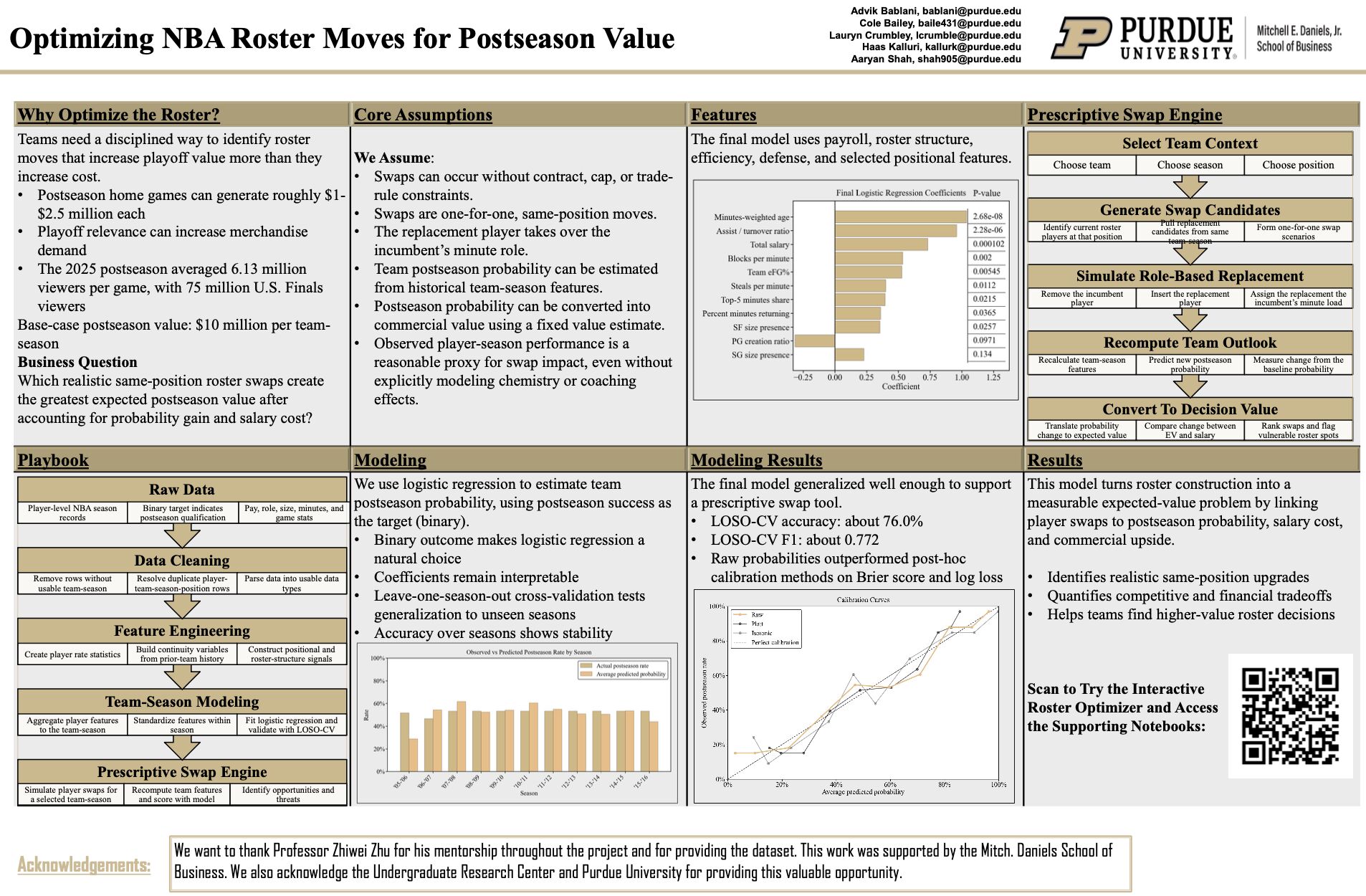
Modeling. A logistic regression estimates team postseason probability with postseason success as a binary target, a natural fit that keeps coefficients interpretable. The final model draws on payroll, roster structure, efficiency, defense, and positional features; minutes-weighted age, assist/turnover ratio, and total salary were the strongest predictors. Generalization was tested with leave-one-season-out cross-validation, and accuracy stayed stable across seasons.
Prescriptive swap engine. On top of the model sits a five-step tool that turns a prediction into a decision:
- Select team context (team, season, position)
- Generate one-for-one, same-position swap candidates
- Simulate the role-based replacement (insert the candidate into the incumbent's minutes)
- Recompute the team outlook and new postseason probability
- Convert the probability change to expected value, compare against salary, and rank the swaps
Results
The model generalized well enough to drive the prescriptive tool: about 76.0% leave-one-season-out accuracy and an F1 of roughly 0.772, with raw probabilities outperforming post-hoc calibration methods on Brier score and log loss. The end result identifies realistic same-position upgrades, quantifies the competitive-versus-financial tradeoff, and flags vulnerable roster spots, and the project placed 3rd in a project showcase.
Honest notes
- A five-person team project mentored by Prof. Zhiwei Zhu, who provided the dataset. This page summarizes the project I worked on, not solo work.
- The poster includes a QR code to an interactive roster optimizer and supporting notebooks.
Curious about the swap engine?
I'm happy to talk through the modeling and the expected-value framing.