Mix Forecasting: 2-Stage Hierarchical Demand Forecasts
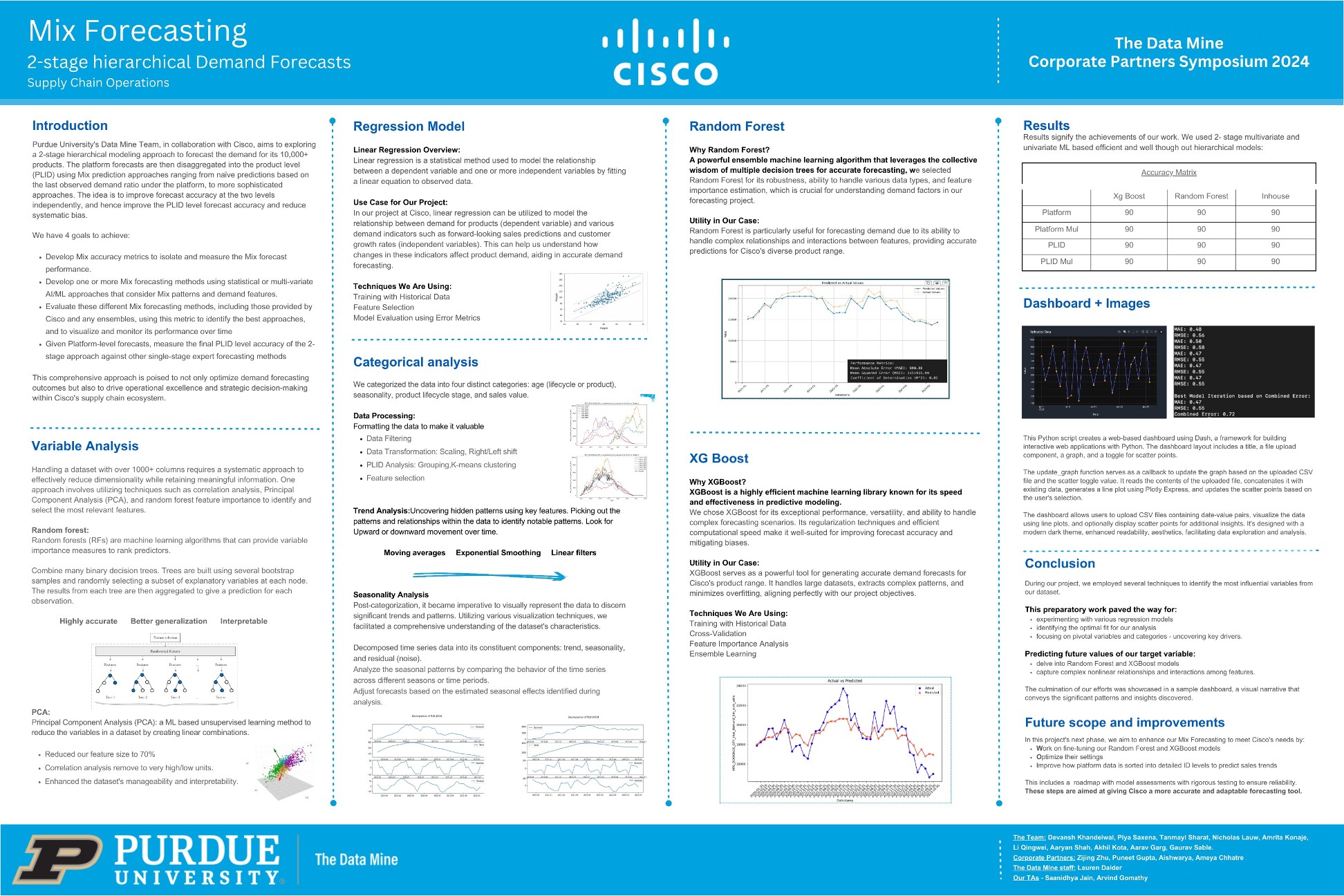
A two-stage hierarchical demand-forecasting approach for Cisco's 10,000+ products: forecast demand at the platform level, then disaggregate down to the individual product (PLID), aiming to beat the naïve last-ratio methods used for that split.
View the full research poster ↗The problem
Cisco forecasts demand across a catalog of more than 10,000 products. Platform-level forecasts are disaggregated to the product level (PLID) using a "mix" prediction, historically leaning on naïve approaches based on the last observed demand ratio under each platform. The team's goal was to model both levels independently with statistical and ML methods, improve PLID-level accuracy, and reduce systematic bias in the split.
Four goals framed the work:
- Build Mix accuracy metrics to isolate and measure mix-forecast performance
- Develop one or more mix-forecasting methods using statistical and multivariate AI/ML approaches
- Evaluate those methods, including Cisco's own and ensembles, to identify the best approaches
- Measure final PLID accuracy of the two-stage approach against single-stage expert methods
Approach
Data & features. The dataset ran to 1,000+ columns. The team used correlation analysis and Principal Component Analysis to cut the feature set to roughly 70% while keeping the signal, plus K-means clustering to group PLIDs. Data was categorized by product age / lifecycle, seasonality, and sales value, and time series were decomposed into trend, seasonality, and residual components.
Models. Three families were trained and compared, in both univariate and multivariate forms:
- Linear Regression: a baseline to model demand against forward-looking sales indicators and customer growth
- Random Forest: for robustness, mixed data types, and feature-importance estimation
- XGBoost: for speed, regularization, and handling complex nonlinear demand patterns while limiting overfitting
Each model was validated against historical data with cross-validation and error metrics, and the two-stage output was compared against single-stage expert forecasts.
Results
On the team's accuracy matrix, the platform and PLID models scored around 90% across XGBoost, Random Forest, and Cisco's in-house model, with an R² of about 0.82 on the platform forecast and best-model selection driven by a combined-error metric. The work was packaged into an interactive Python / Plotly Dash dashboard (CSV upload, line plots, and a scatter-point toggle on a dark theme) so the partners could explore forecasts and drivers directly.
Honest notes
- This was a team effort within Purdue's Data Mine: the poster credits ten student contributors plus Cisco supply-chain partners and Data Mine staff. This page summarizes the project I worked on, not solo work.
- The underlying data and code are Cisco-confidential; the poster and methodology shown here are the public artifacts.
Want the deeper version?
Happy to walk through the modeling choices and the two-stage tradeoffs.